
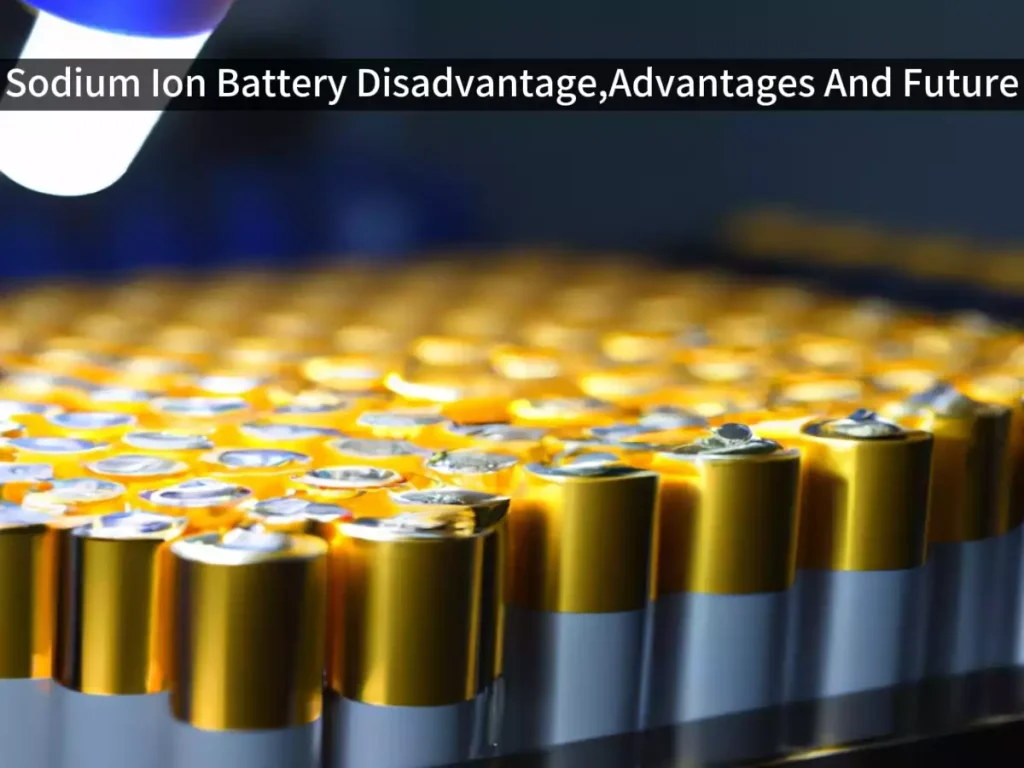
Sodium, as an element that is abundantly available on Earth, has become an ideal candidate. In this paper, we will discuss the sodium ion battery disadvantages ,advantages and future potential.
With the rapid progress of the times and the significant improvement of people’s quality of life, electronic products have been deeply integrated into every corner of daily life, from portable rechargeable headphones, smart sports bracelets, smart phones, to grand electric airplanes and electric boats, all of which demonstrate the power of science and technology. The smooth operation of these high-tech devices can not be separated from the efficient and stable battery technology as a source of energy, in which the lithium-ion battery since its commercialization in 1991, by virtue of its excellent
performance, quickly in the field of the 4C (computers, communications, networking and consumer electronics) to occupy a central position, and in the field of electric vehicles to show a strong momentum of development.

However, in the face of the growing demand for secondary batteries in the global energy storage market, lithium-ion batteries are faced with the serious challenge of limited and uneven distribution of lithium resources, which to a certain extent restricts their comprehensive expansion in 4C products, electric vehicles and large-scale energy storage. In view of this, the exploration and development of new energy storage battery technology has become an industry consensus and urgent needs.Against this background, sodium-ion batteries stand out with their unique advantages – abundant resources, low manufacturing costs and excellent overall performance, providing a feasible solution to alleviate the supply and demand contradiction brought about by the shortage of lithium resources. As a powerful complement to lithium-ion batteries, sodium-ion batteries are expected to play a key role in the field of new energy storage, promote the diversified development of energy storage technology, and contribute to the construction of a greener and more sustainable energy system. In the future, with the continuous maturation of technology and further cost reduction, sodium-ion batteries are expected to be widely used in many fields, opening a new chapter in energy storage technology.

Low energy density
At present, lithium ternary generally in 250wh/kg, lithium iron phosphate in 180wh/KG, and sodium battery layered oxide will be around 130wh/kg. Polyanion material will be around 110wh/kg.
Lower cycle times
The popular sodium battery layered oxide system on the market nowadays, the cycle times of the battery cell is about 4000 cycles, made of square aluminum shell, it is about 2000 cycles. Of course, do not rule out with the development of technology, density and cycle times upward.
Technology is not mature enough
Due to the high price of lithium carbonate in 2022, resulting in the rapid development of sodium-ion to 2023, but sodium-ion batteries in lithium carbonate 300,000 yuan / ton slowed down, lithium carbonate 150,000 yuan / ton on only a small number of companies are still vigorously research and development, the current lithium carbonate 100,000 yuan / ton, the price of sodium-ion does not take advantage of the majority of companies only input, a moment to see the profitability.
Application scenarios
Sodium ion just started out of the positioning is as a lithium-ion battery supplement, application scenarios are also low-speed car + energy storage

Richer resources
Sodium resources accounted for 2.75% of the crust resources, while lithium only accounted for 0.0065%, a difference of 423 times, reflected in the price, the current lithium carbonate more than 150,000 per ton. Sodium carbonate 40,000 per ton, the difference between the two 4 times or so (although this is not the final battery cost, the current stage of lithium carbonate 100,000 or so, the price of sodium-ion battery price maturity is not enough, the price has no obvious advantage)
Sodium salt is evenly distributed
Global rainfall, and lithium resources only South America’s Bolivia, Argentina and Chile three countries occupy 56% of the world.
Relatively better safety
Sodium batteries are safer, low temperature rise, low heat, the current experiments for lithium batteries can not let the sodium battery fire (strictly speaking, it is not not on fire, but relative to lithium will be safer).
Low temperature performance
Currently, the low temperature performance of lithium-ion batteries is insufficient, but sodium-ion batteries from -20 degrees to +80 degrees can maintain 100% of the rated charge, -40 degrees can also be >70%. Lithium batteries want to do this level of requirements must be added special electrolyte.
Excellent multiplication performance
The solvation energy of sodium ion is lower than that of lithium ion, i.e., it has better interfacial ion diffusion ability; at the same time, the electrolyte with the same concentration has higher ionic conductivity than that of lithium salt electrolyte, therefore, the multiplication performance of sodium-ion batteries is better, and the power output and acceptance ability is stronger.
Lower theoretical cost
In fact the anode material, electrolyte, diaphragm and collector of sodium battery are all cheaper than lithium battery. For example, sodium battery collector is aluminum foil, lithium battery is copper foil. If the sodium battery industry chain really spreads mass production, it will greatly reduce the cost.

Sodium ion battery have great market potential in the future, especially in energy storage devices and some specific application scenarios. With the continuous progress of technology, the energy density and cycle life of sodium-ion batteries are expected to be significantly improved. Many companies and research institutions have already invested a lot of resources in research and development, hoping to occupy a place in the future battery market.
Electric Vehicle Market
Sodium ion battery are an alternative to lithium ion battery in electric vehicles (EVs). By utilizing sodium as a charge carrier, sodium ion battery can help reduce dependence on scarce lithium resources. This may reduce the cost of electric vehicles and make them more accessible to more consumers.
Large-scale energy storage
Sodium ion battery have potential applications in large-scale energy storage systems, such as grid-scale energy storage and renewable energy integration. These batteries can store excess energy during periods of high production and release it during times of high demand, contributing to a more stable and reliable grid.
Portable electronic devices
Sodium ion battery can also be used in portable electronic devices such as smartphones and laptops. Because sodium is more abundant and less expensive than lithium, sodium ion battery could provide a more cost-effective solution for powering these devices, making them more affordable for consumers.


